Things I Like
Estimated reading time: ~4 minutes with ~670 words.
I did a guided visit of the Austrian Parliament last week as a part of COMSOC 2025, and our guide was an Austrian architect who kept pointing out modern art installations which were scattered throughout the building that were “great” that he really liked. One of them was the following painting (four of which span the entire room).
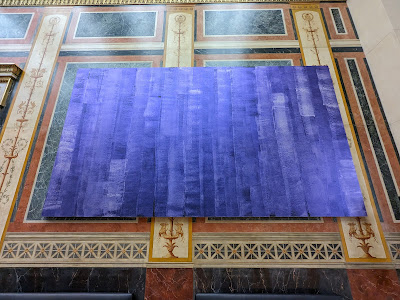
He pointed out (at least) two things that he liked about the painting: it has different shades when you view it from different angles, which represents people with different view points discussing the same thing; the dimensions of the painting represent the size of an average Austrian house (as opposed to the oversized Parliament building), which is supposed to remind the politicians who they are really working for.
I like knowing that the dimensions of the painting are the size of an average house. It feels poignant. When I am informed of this fact about the painting, I like and appreciate this fact. Does this mean I like the painting? I do not think so. I am partial to admiring things before I understand them. Most works of literature I have read, I do not understand them (in the sense of giving it deep thought) as I read them11 1 The first time I read The Brothers Karamazov, I liked it so much I went around telling people how great it is. One prof told me he had read it several times and grilled me on the Third Meeting of Ivan with the Devil. I did not recall any such incident, much to his ever increasing bafflement and dismay.. Yet, I am influenced by them and I am stirred. When I put in some effort to understand them, I begin to like these things more than I did earlier.
This seems to me like the dichotomy between things I dislike and things I like. The latter, I have an instinctive liking for. As I learn more about them, this liking increases. The former, I dislike instinctively. As I learn more about them, I like the information that I learn about them, but this does not lead to change in opinion of the object itself.
I read an article on how the invention of the camera accelerated the rise of abstract art since the earlier artistic ideal of reproducing the world as-is was now devalued by this invention that could perform such reproductions cheaply and at scale. Technological progress had decoupled the measure of technical ability of artists from the aesthetic pleasure one derives from viewing said artistic piece.
Would LLMs also have a similar effect on literature? They can write a stirring monologue or a poem much better than I can for what its worth. Has this already happened to poetry? Have we progressed so much that post-modern fiction arrived before LLMs? I tried reading Midnight Is Not in Everyone’s Reach and it requires so much concentration that I gave up. Of course such books already existed, but maybe the effort one puts into reading a book is what makes a book good.
2026-01-16: Adam Kirsch, writing in (for?) The Atlantic, says
[…] the rise of AI writing represents a great opportunity for literature, even as it makes life harder for professional writers. When photography was developed in the 19th century, it replaced painting for most utilitarian purposes; a camera could document what things looked like more accurately and cheaply than a painter could. But the art of painting didn’t die out. On the contrary, it entered a golden age: Freed from the obligation of realism, painters developed radical new ways of seeing, such as Impressionism, Cubism, and abstract expressionism. Now AI has the potential to liberate literature in the same way. In a world full of emptily competent prose, we need writers daring, challenging, and obstinate enough to tell us what it’s like to be human, “from the inside”.
Being “freed from the obligation of realism” seems to make things incompatible with my tastes. I agree with all the things in the article, except for adding a (derogatory) at the end of it. I am still figuring out how this opinion of mine for the arts interacts with the research topics that I choose to pursue my career in.