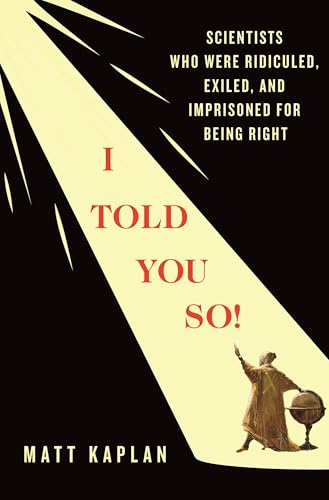
I Told You So!
In her memoir, Kati commented, “There were so many researchers who worked beautifully within the system… by nearly every measure, they were successful. But they were so incurious!”
A nice easy-to-read book about people discovering that the dominant scientific notion at that point of time is wrong, and the social ostracization from other scientists who refuse to hear another word about it. The connecting thread across all chapters is the story of Ignaz Semmelweis, who I knew earlier purely as the doctor who asked people to wash their hands before delivering babies, and was locked up in a mental asylum and beat to death for the absolute nerve to suggest such a thing. Does not seem to exactly be the story here, but close enough, with a lil’ bit o’ dramatic flair.
The book is written in peak ADHD style (what’s the actual name for this?), flitting in and out of various character arcs to make this point or that about whats bad with the socials of science. I quite like it, and this seems like a better way of introducing lots of characters than the usual Wikipedia dump style followed by, say, Tom Griffiths.
He talks about marginalized people who face resistance for wacky/non-mainstream ideas. Does he ever talk about “non-marginalized” people having revolutionary ideas that change a field overnight? Does Pasteur count?
A lot of the book also covers who gets funding, who gets recognition, how science needs to be overhauled in the current era, etc. I think with LLMs, the overhaul is going to happen regardless, the question is how and in what direction. Reactionarily, the questions discussed here seem moot compared to how the work I do has changed in the last few weeks. Naturally, this is not a long-term prediction and is purely reactionary, but I’m not sure any of this is going to sustain the same way. The way it is affecting fields other than mine, I assume, is by speeding up coding and making it easier to iterate on models. It would be good for me to figure this out at some point.
She copes by applying for grants that fund her to explore other aspects of ecology and then quietly redirects some of that money toward the work that she knows is so important.
I know about people redirecting funds from one project to work on the thing they really want to work on, but I’m surprised people admit to it on record. I should sit and do a deep dive one day on research funding. Maybe one reason for my reticence is that, if I were in charge of all research funding, I would prefer to fund work different from mine even though I find my questions (in a vacuum) interesting. Maybe figuring out what makes people fund this exact research would make me more inclined to continue doing the same stuff.
What do I think of Pasteur’s methods of science “exposition”? He clearly did great things, and tried to minimize the perception of how much effort went into his research as much as possible. Sounds much like how math papers are written right now. His way of screwing over other people who arrive at the same conclusions is clearly terrible. I feel like when I try to present my research, I go for the flair as well (without nearly as much depth as Louis’ results). There is a difference between the way I give talks and Anupam Gupta does. I try to go for the stand-up comedy route of keeping a talk engaging. Anupam does it with just the math. He does have advice on how to give good talks. Maybe one day I shall revamp my presenting style, but its likely that my improvement process is more non-differentiable than smooth.
Continuing the typo thread from the last two books, I was on the lookout for typos to catch. There were absolutely none that I could spot, except for Gary Vermeij being spelt as both Gary Vermeji and Gary Vemeij (was his name correctly written anywhere in the book?). While starting to write about the books I’ve read, finding typos was not one of the things I thought would take such a centerstage.
After spending almost five years in Vienna, this quote from Adolf Kussmaul is a good place to end my thoughts on this book.
In Austria a revolting system of favouritism dominated everywhere: there were incompetent professors and chief physicians who owed their appointments to the patronage of distinguished petticoats and influential cowls.
Comments