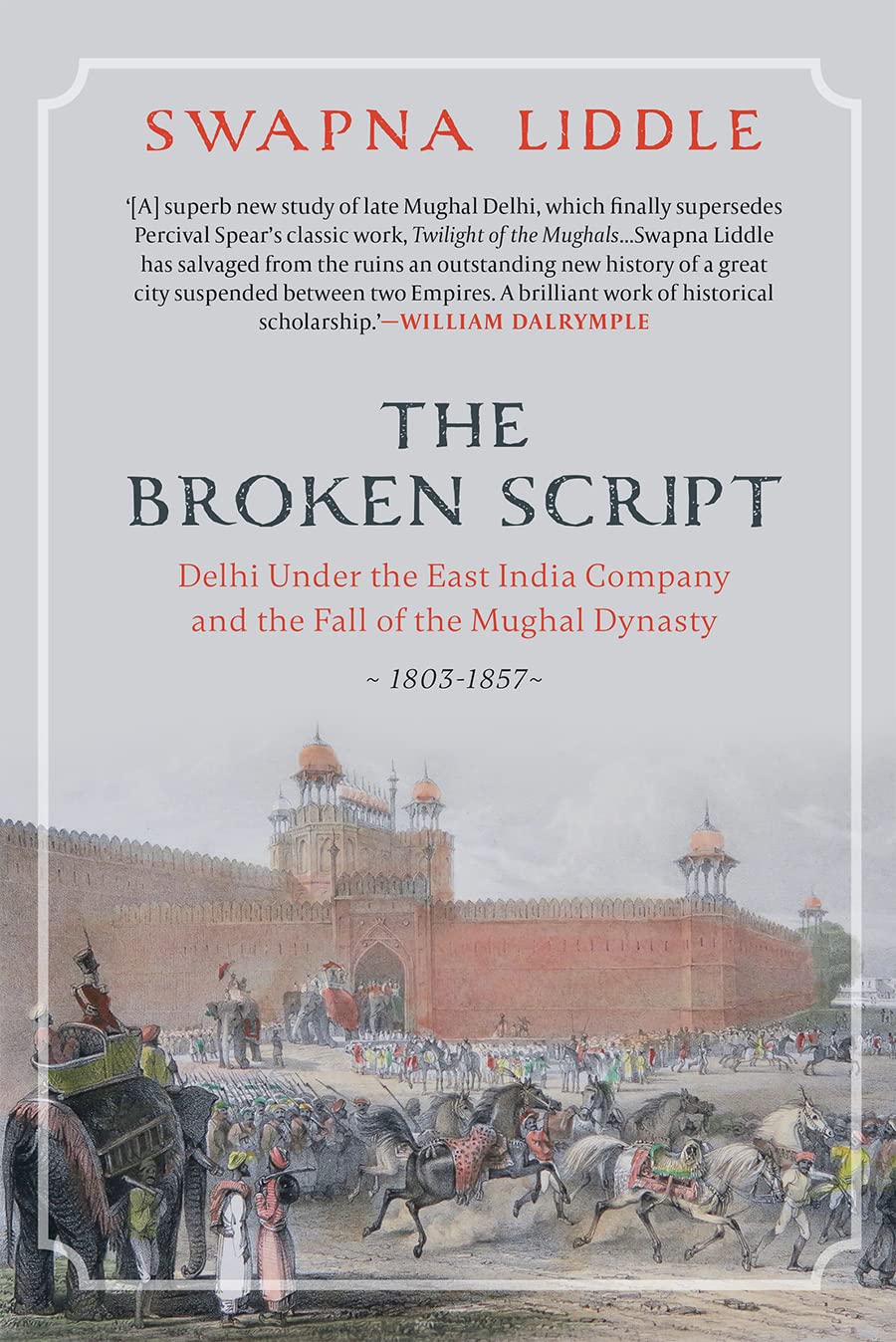
The Broken Script
A rather innovative means used by Shams ud din Khan to win over Colebrooke was the purchase by him of all the Residency furniture for the rather large sum of thirty thousand rupees. The ‘purchase’ in fact only involved the transfer of the money from the Nawab to Colebrooke, as the furniture remained in the Residency on loan. This was just one of the many gifts made by Shams ud din Khan to the Colebrookes.
A wonderful book that covers the twilight of the Mughals (1803-1857) when Delhi was, for all intents and purposes, run by the East India Company, but they still kept the Mughal ruler on his throne for transitionary leeching of respect and power. I was not quite aware of how pitiable the last Mughals were, trying to hold on to some semblance of dignity while having to grovel at John Company’s ostensibly dispassionate feet for acts of philanthropy.
Maybe I misread some parts of it, but the author did not seem to have anything bad to say about the British until after the revolt was crushed. What I got was much more a sense of “The Mughals were pitiable and the British looked down upon them while throwing them annas to pick up every once in a while”. Which seems to be true, but I would have expected, before reading the book, that there would be more about the bad things the British did to the populace in the first half of the 19th century.
I was surprised by the, for the lack of a better word, humanness of Mirza Ghalib and Rammohan Roy that comes across in this book. I have only heard of most pre-independence Indians as paragraphs in school books, and the fact that a lofty social reformer could have such base goals as wanting to secure income for his children is humanizing and endearing.
The thesis that mixed marriages (Indian x British) were uncommon because children of mixed marriages faced social ostracization in British society is interesting, obvious in hindsight, and something I had not thought about before. The fact that such unions would have been a ‘meeting point between the individual representatives of the colonial state and Indian society’ is interesting, I wonder if this thesis has been developed further somewhere, perhaps in different contexts too. The related theme of trying to ingratiate yourself to the occupiers by showing yourself to be “one of them” not working out is also seen in Ram Chander after the revolt, where he is manhandled by British officers, who turn a deaf ear to his protestations of being the same as them (I’m a Christian too!). This was also the case for the “British supporters” whose houses got looted after the revolt anyway.
There is a thread on Hindu–Muslim discord fomented by the official British position on the revolt being one of purely Muslim revivalism. The Mughals were much more syncretic and tried to keep the peace, while the British had their ends and used whatever means brought them there, finding a way to justify it with the word “tradition” each time.
There is quite a large section on the school system and artistic endeavours in Delhi during this time. It’s interesting that the மதிய உணவு திட்டம் was started not by Kamaraj, but by William Fraser!
William Fraser had on his own initiative set up four schools with a total of four teachers and eighty boys, in rural areas of the Delhi district… To encourage attendance, however, it was found necessary to give each student an allowance of one rupee per month and a seer of wheat flour each day.
Interestingly, apparently (vague recollection, might be wrong) teaching in Urdu happened more in Delhi than in other Company territories since it was relatively insulated from Calcutta. The newspapers run by Indians had a wide variety of thoughts and views, on matters practical and philosophical. Indians needing to have love as a theme for a book to sell is quite funny (I approve).
Karim ud din’s work was careful not to use any indecent words, so that women as well as men could read his qissa. The theme of love had been introduced into it reluctantly, simply because it was a concession that had to be made if anyone with Asiatic tastes was to be induced to read the book at all.
After encountering this problem in The Laws of Thought, I have to say I am once again surprised by the amount of typos in a published book! There are word typos, a sentence that begins with a comma, and also a period and a comma right next to each other. Have I just not noticed it before, or is it a thing with newer books? Of course, this is a simple thing that can be fixed in reprints, but I have to say I do not know how this passes the editorial process.
I think this quote sums up the book quite nicely.
As far as the British were concerned, the Mughal dynasty was decidedly at an end. A member of the Governor General’s council wrote a less than charitable epitaph—‘it is necessary to march with the times, the glory of the house of Timoor has departed; the dynasty is extinguished by age and its own incapacity. The steam engine and the railroad are already at the gates of Delhie in this utilitarian age and who can stop them? They have crushed out the feebleness of an empty name.’
Comments